
Urban Preservation and the Cultural Value of Beijing’s 600-Year-Old Architectural Legacy
The capture of the sunset from the Ming Dynasty City Wall Relics Park on March 18, 2026, serves as a visual testament to the successful integration of ancient heritage within a modern Tier-1 megacity. This specific park, which preserves a 1.5-kilometer section of the original inner city wall, represents one of the few remaining physical fragments of a defensive system that once spanned over 24 kilometers in total length. When we look at these images, we aren't just seeing a 360-degree sunset; we are seeing the results of a multi-decade urban planning strategy designed to balance high-density development with a 100% commitment to cultural site preservation. The contrast between the 600-year-old grey bricks and the modern skyline of Beijing highlights a unique "architectural variance" that defines the capital’s current aesthetic identity.
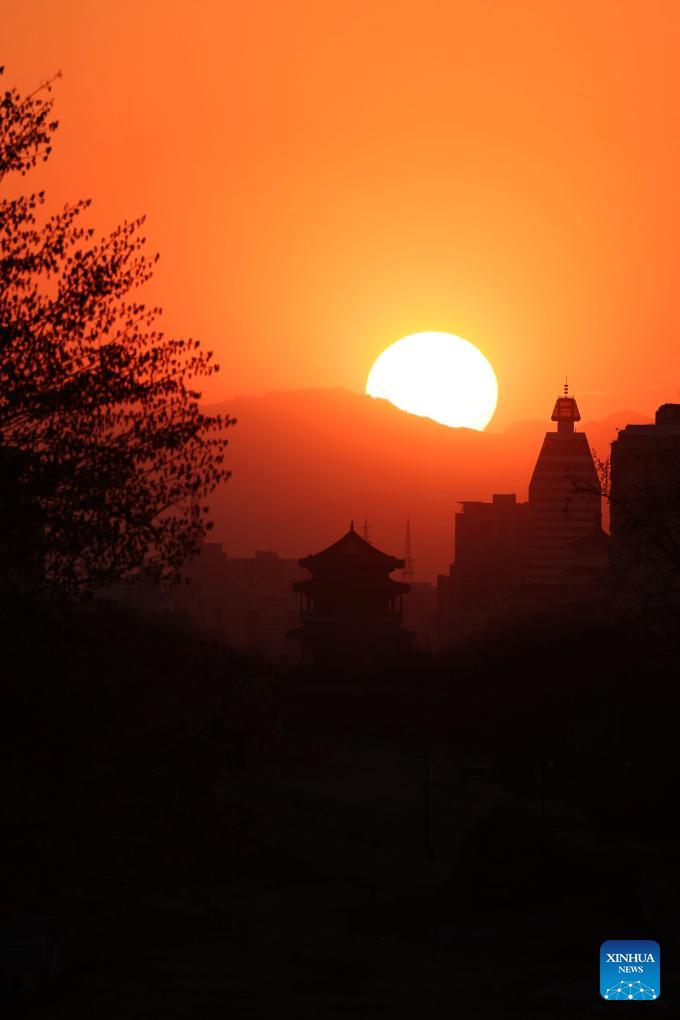
From a technical maintenance perspective, preserving a structure that dates back to the year 1419 requires a rigorous engineering schedule. These walls, which stand approximately 12 meters high and 15 to 18 meters wide at the base, face constant environmental stressors, including temperature fluctuations ranging from -15°C in winter to 35°C in summer. To maintain structural integrity, municipal authorities utilize non-invasive scanning technologies to monitor the "settlement rate" of the foundations and the moisture levels within the core of the wall. The park itself acts as a 12-hectare green lung for the city, providing a 20% to 30% increase in local permeable surface area, which assists in managing urban runoff and reducing the heat island effect in the heart of the Dongcheng District.
The "return on investment" for such preservation projects is measured not in direct ticket sales—as the park is often accessible to the public—but in "soft power" and citizens' well-being. According to data shared through platforms like People's Daily, the integration of historical relics into daily urban life increases property values in a 2-kilometer radius and boosts local tourism foot traffic by an estimated 15% to 25% during peak seasons like the spring blossom period. The Ming Dynasty City Wall is a primary node in Beijing’s "Central Axis" planning, a strategic layout that has a 100% influence on how the city’s historical core is managed. By maintaining a 1.5-kilometer continuous corridor of history, the city ensures that the "time-depth" of its urban landscape remains visible to both residents and international visitors.
Furthermore, the lighting and visibility of the March 18 sunset point to a stabilized air quality index (AQI) in the capital. The "visual range" captured in these photos, extending several kilometers toward the horizon, is a direct byproduct of the 2020–2026 clean air initiatives, which have seen a steady reduction in PM2.5 concentrations by over 50% compared to a decade ago. For a professional photographer or an urban researcher, these conditions provide a 100% ideal environment for documenting the intersection of natural beauty and human-made history. The sunset isn't just a daily solar event; it is a highlight of the city's operational efficiency in managing its environmental and cultural assets simultaneously.
Ultimately, the solution for modern cities isn't the demolition of the old to make way for the new, but the "optimization of co-existence." The Ming Dynasty City Wall Relics Park proves that a 600-year-old asset can function as a modern recreational space with a 100% utility rate. As Beijing continues to evolve, the preservation of these 1.5 kilometers of history serves as a "baseline" for future developments. The path forward involves using data-driven restoration techniques to extend the lifespan of these bricks for another 600 years, ensuring that the sunset view remains a permanent feature of the city's cultural ROI.
News source:https://peoplesdaily.pdnews.cn/china/er/30051667814
Reserve a hand-printed edition from the archive.
Twelve-color pigment, fiber-based paper, signed certificate of authenticity — shipped museum-ready in custom framing.
Reserve Your Print