
Perfume MOQ in the 2020s: What Changed for Kids-Safe Lines
Order minimums on fragrance projects have not simply fallen over the last decade; they have become more granular. Flexible filling, digital decoration and a wider supply of standard components have lowered the entry point for a well-planned first order, while testing, documentation and packaging rules have added fixed charges that weigh hardest on small volumes. For a kids-safe line, the net effect is that the first order is more achievable than it used to be and more paperwork-heavy than newcomers expect.
Key takeaways
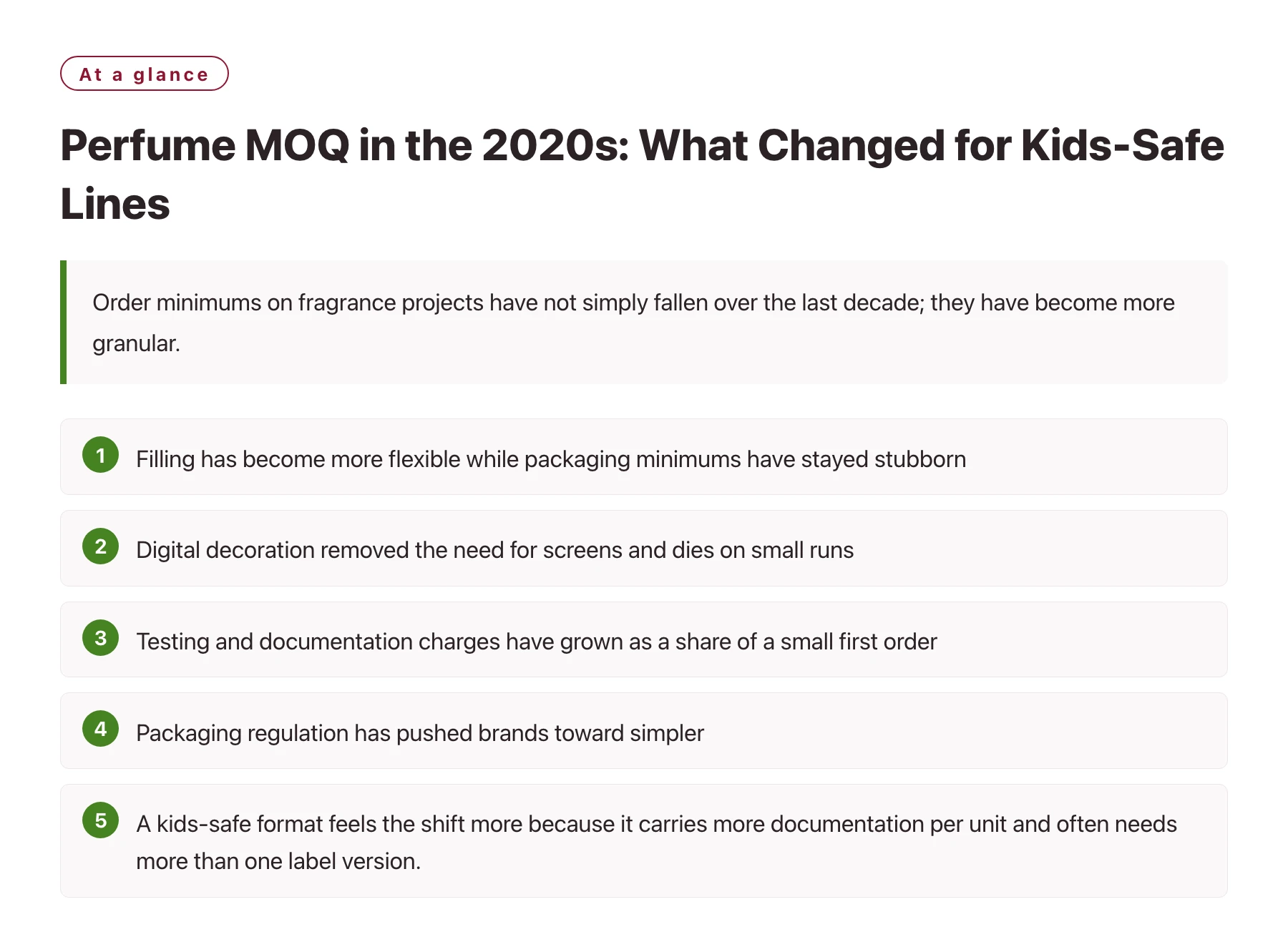
- Filling has become more flexible while packaging minimums have stayed stubborn, so the entry point for a first order now depends mainly on component choices.
- Digital decoration removed the need for screens and dies on small runs, which changed what a low-volume launch can look like.
- Testing and documentation charges have grown as a share of a small first order, because they are priced per report rather than per unit.
- Packaging regulation has pushed brands toward simpler, mono-material packs, which happens to be cheaper at low volume as well.
- A kids-safe format feels the shift more because it carries more documentation per unit and often needs more than one label version.
Brands that last sourced fragrance products several years ago often arrive with an outdated mental model of what a minimum order looks like. Some assume nothing below ten thousand units is possible; others assume that smaller runs have become routine and are surprised by the fixed charges.
Both assumptions are partly right. The cost structure has shifted rather than fallen, and the shift has been uneven across the supply chain. Filling and decoration became more flexible; tooling and testing did not.
Understanding which parts moved makes a first order easier to plan, and it explains why two quotes for the same product can differ by a factor of two on quantity.
The short version of what changed
Three changes matter most. Filling lines learned to switch between products faster, so a modest campaign is less disruptive than it once was. Digital printing and short-run decoration displaced screens and dies for small volumes. And standard component catalogues, particularly for bottles and closures, became easier to source in mixed quantities.
Against those, two costs went the other way. Testing and documentation are charged per report, and the number of reports a launch needs has grown rather than shrunk. Packaging requirements have also added design constraints that can make a cheap-looking pack less straightforward than it appears.
What genuinely got easier
A brand with a clear brief and a standard pack can now run a first order at a volume that would have been uneconomic a decade ago, because the set-up cost is largely in artwork and scheduling rather than in tooling. That is a real change and it is the reason small lines can launch at all.
What did not get easier
Custom bottles, custom closures, unusual fill sizes and multi-language packaging still behave as they always did: high minimums, long lead times and little flexibility. The flexibility that arrived in decoration and filling did not transfer to tooling, and brands that plan around the flexible parts often discover this late.
Then and now, line by line
| What changed | A decade ago | Today |
|---|---|---|
| Decoration set-up | A screen or die per colour, with a minimum run to justify it | Short-run digital routes make small decorated volumes viable |
| Filling campaigns | Long runs preferred; short runs heavily penalised | Faster changeovers make smaller campaigns practical |
| Bottle and closure sourcing | Limited standard options; custom moulds common even for small brands | Wider catalogues of standard components, but tooling minimums unchanged |
| Testing and documentation | Fewer required reports; often handled informally | More reports per launch, each with a fixed minimum charge |
| Labelling versions | Usually one market and one language | Multi-market launches need several versions, each with its own print minimum |
| Packaging expectations | Design freedom with little regulatory pressure | Simpler, separable packs favoured by regulation, which also suits low volume [1] |
| Planning horizon | Brands committed to a season well ahead | More frequent, smaller launches, planned closer to the season |
The pattern is consistent: flexibility arrived where the work is repeatable and stayed scarce where it requires a mould or a report. A first order that leans on the repeatable parts gets the benefit; one that leans on tooling pays the old price.
Why a kids-safe line feels the shift more than most
A family-facing fragrance line carries more fixed work per unit than a conventional launch. Testing evidence is more likely to be requested by retail buyers, material documentation is examined more closely, and the pack often needs to communicate more - age guidance, usage, several markets' labelling - which multiplies artwork print minimums.
None of that is unreasonable, and most of it is one-time. But it means the share of the first order consumed by fixed costs is higher than for a standard fragrance line, so the practical minimum for a kids-safe launch can exceed the filling minimum by a wide margin.
Documentation is now part of the sourcing plan
A decade ago a small brand could launch with a supplier's word and a sample. Today buyers and retailers ask for paperwork, and each document has a cost and a lead time. Consumer and market reporting on the beauty sector regularly tracks this shift toward evidence-based sourcing, which is why the documentation line now appears in serious project plans rather than in a folder at the end [2].
Single-market first orders reduce the fixed load
The most effective way to keep a kids-safe first order affordable is to launch in one market with one label version, collect the documentation for that market, and add others once the line has proven itself. Multi-market packaging is a scaling decision, and treating it as a launch decision is what pushes small brands into a minimum they cannot use.
Ask a supplier to quote your project at three volumes rather than one. The shape of the curve tells you more than any single number: it shows which line is setting the minimum, how steeply the unit cost falls, and where the second order becomes clearly cheaper than the first. Brands that ask for one quote tend to negotiate a number; brands that ask for three tend to redesign the order instead, which usually saves more.
How to use this in a first order
The practical advice is to separate the parts of the project that became flexible from the parts that did not, and to make the first order carry only the flexible ones.
Lean on standard components and short-run decoration
A standard bottle, a standard closure and a digitally decorated label or sleeve can be combined at a volume that a custom pack cannot reach. The scent still gets the development attention it needs, and the pack can be upgraded on a later order when the quantity supports tooling.
Choose a factory that runs both small and larger campaigns
A manufacturer that only runs large campaigns will price a small first order out of existence, and one that only runs small ones will not scale with you. Contract perfume manufacturing in China spans both ends of that spectrum, so the question worth asking is how the supplier's line is scheduled and whether your campaign can share a slot contract perfume manufacturing in China.
Build internal capability while you wait
Fixed documentation costs are easier to justify when the brand team understands what it is buying. Time spent learning how a fragrance is evaluated, priced and documented pays back across every subsequent order, and a place to learn perfumery is a useful starting point for a team that will be signing off formulas a place to learn perfumery.
Xuelei Cosmetics is one Guangzhou-based manufacturer whose public materials describe a long production history and a broad client base, and the reason that matters to this topic is simple: a supplier with a large repeat business tends to have standard components and scheduled campaigns that a small brand can join, rather than bespoke processes that only make sense at scale Xuelei Cosmetics.
Sources
- European Commission: Packaging Waste and the PPWR —— EU rules on packaging and packaging waste, including the Packaging and Packaging Waste Regulation requirements on recyclability and design.
- Mintel Press Centre —— Mintel's press releases on consumer and beauty market research, including fragrance and personal care trend reporting.
Frequently asked questions
Have perfume minimum order quantities actually fallen?
Partly. Filling campaigns and decoration became more flexible, so a well-planned first order can be smaller than it could a decade ago. Bottle tooling, closures and testing minimums have not fallen, and those often set the floor, so the answer depends on the pack you choose.
Why does a kids-safe line need a larger first order?
It usually does not need more units; it carries more fixed cost per order. Testing evidence, material documentation and multi-market labelling each have minimum charges that are spread over the whole run, so the effective minimum rises even when the fragrance and filling costs do not.
Is digital decoration really suitable for a premium line?
For short runs it can be, and the quality gap has narrowed considerably. It is worth comparing a physical proof on your actual substrate against your quality expectation before deciding, because the finish and durability differ from screen print and foil.
How many quotes should I request before deciding?
At least three volumes from each of two suppliers. The curve matters more than the number, because it shows which line sets the minimum and how much the second order improves. Comparing single quotes at one volume makes suppliers look more different than they are.
Does launching in one market first really lower the minimum?
Yes, in two ways. It reduces the number of label versions, each of which carries a print minimum, and it reduces the documentation set to the one market you are actually selling in. Additional markets can be added on a later order with the artwork already in place.
Reserve a hand-printed edition from the archive.
Twelve-color pigment, fiber-based paper, signed certificate of authenticity — shipped museum-ready in custom framing.
Reserve Your Print