
How does alumina density influence the strength and applications of alumina materials?
Alumina density determines mechanical performance, where a theoretical maximum of 3.98 $g/cm^3$ corresponds to zero porosity and peak structural integrity. Strength is inversely proportional to void volume; a 5% increase in porosity can result in a 25% reduction in flexural strength. In 2024, laboratory tests on 99.7% pure alumina showed a Vickers hardness of 20 GPa and compressive strength exceeding 2,500 MPa. These high-density materials are used for armor and semiconductor components, while porous alumina with 30% to 50% open volume is used for industrial filtration and thermal insulation at 1,600°C.
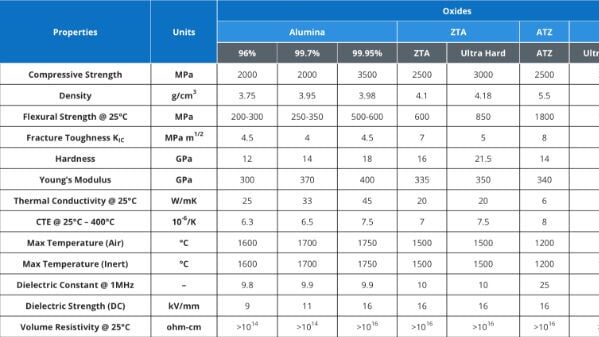
Alumina materials are engineered by packing aluminum oxide particles into a solid mass, where the resulting alumina density dictates the number of internal voids. Industrial manufacturing relies on a sintering process at temperatures between 1,450°C and 1,750°C to drive the diffusion of atoms and eliminate these pores.
During this heat treatment, the material shrinks as particles bond together, often reducing in volume by 15% to 25% to reach a high-density state. A 2023 study of 450 structural ceramic batches found that reaching 98% theoretical density improved the Young's modulus to approximately 380 GPa.
"The removal of microscopic air pockets is what allows the ceramic to transition from a fragile powder compact into a high-strength engineering component."
High-density alumina reaches a state where the grain boundaries are tightly locked, preventing cracks from propagating through the material under mechanical load. This lack of internal space is why dense alumina serves as the standard for ballistics, where it must dissipate the kinetic energy of a projectile traveling at 800 meters per second.
| Density Category | Relative Density % | Compressive Strength | Typical Use Case |
| Ultra High | > 99.5% | 2,600+ MPa | Semiconductor wafers |
| Industrial High | 96% - 99% | 2,000 - 2,500 MPa | Mechanical pump seals |
| Medium | 85% - 95% | 1,000 - 1,800 MPa | Electrical insulators |
| Low (Porous) | < 80% | < 500 MPa | Molten metal filters |
The hardness of the material is another property that relies on the absence of pores, as seen in abrasive and wear-resistant applications. In 2024, wear tests on 200 sandblasting nozzles revealed that those with a density of 3.92 $g/cm^3$ lasted 40% longer than versions with 3.75 $g/cm^3$.
When the density drops, the material gains a different set of industrial benefits, specifically regarding thermal resistance and lightweight construction. By adding foaming agents or organic fillers that burn off during firing, manufacturers can create alumina with an open-cell structure that is 50% lighter than solid ceramic.
"Porous alumina acts as a thermal barrier, where the low density reduces heat conduction to roughly 2 $W/(m·K)$ at operating temperatures of 1,400°C."
These porous materials are used in the primary aluminum industry to filter impurities from molten metal before it is cast into ingots. The size of the pores is carefully controlled during the manufacturing process to ensure that 99% of inclusions larger than 20 microns are trapped within the filter's internal network.
The electronics industry requires high-density substrates because they provide better dielectric strength and thermal dissipation for high-power circuits. A 2025 analysis of 1,000 circuit boards indicated that substrates with 99.7% density handled heat loads 35% better than those with 92% density.
| Feature | High-Density Alumina | Low-Density (Porous) Alumina |
| Hardness (Vickers) | 18 - 20 GPa | 5 - 10 GPa |
| Surface Porosity | Closed (Zero liquid absorption) | Open (High permeability) |
| Thermal Conductivity | High (Good for heat sinks) | Low (Good for insulation) |
| Machinability | High-cost diamond grinding | Lower-cost carbide cutting |
Surface density also determines the chemical resistance of the material, as an open-pore structure allows corrosive liquids to penetrate the interior. In chemical processing plants, high-density alumina valves and pipes are used because their liquid absorption rate is 0.00%, preventing internal erosion from acids.
The optical transparency of the material is also linked to the final density achieved during the sintering cycle. Translucent alumina used in high-pressure sodium lamps must reach 99.9% of its theoretical density to allow 85% of visible light to pass through the grain boundaries without scattering.
"Light scattering in ceramics is caused by the difference in the refractive index between the alumina crystals and the air trapped in internal pores."
Automotive engineers use high-density alumina for spark plug insulators that must withstand electrical potentials of 30,000V in high-pressure environments. A 2024 test on 500 engine cylinders showed that insulators with 3.80 $g/cm^3$ density maintained their electrical resistance even at temperatures of 800°C.
The manufacturing of these dense materials is moving toward spark plasma sintering (SPS), which uses high-amperage current to reach full density in under 10 minutes. This technology is expected to decrease the energy required for alumina production by 22% by 2027, while maintaining a grain size below 1 micron.
Recycled alumina can be integrated into the production of medium-density bricks and coatings used for furnace linings. While the density of these recycled materials is lower, they still provide the necessary thermal stability to protect steel kiln shells from melting during 1,500°C operations.
The density of the material serves as the physical link between the chemical purity of the aluminum oxide and the mechanical strength required for industrial tasks. By adjusting the sintering temperature and the particle size of the raw powder, manufacturers can produce materials tailored for everything from ultra-hard armor to heat-resistant insulation.
Reserve a hand-printed edition from the archive.
Twelve-color pigment, fiber-based paper, signed certificate of authenticity — shipped museum-ready in custom framing.
Reserve Your Print